 Chandler Pool Acid Wash
 Pool Calcium & Scale Removal in Chandler, AZ
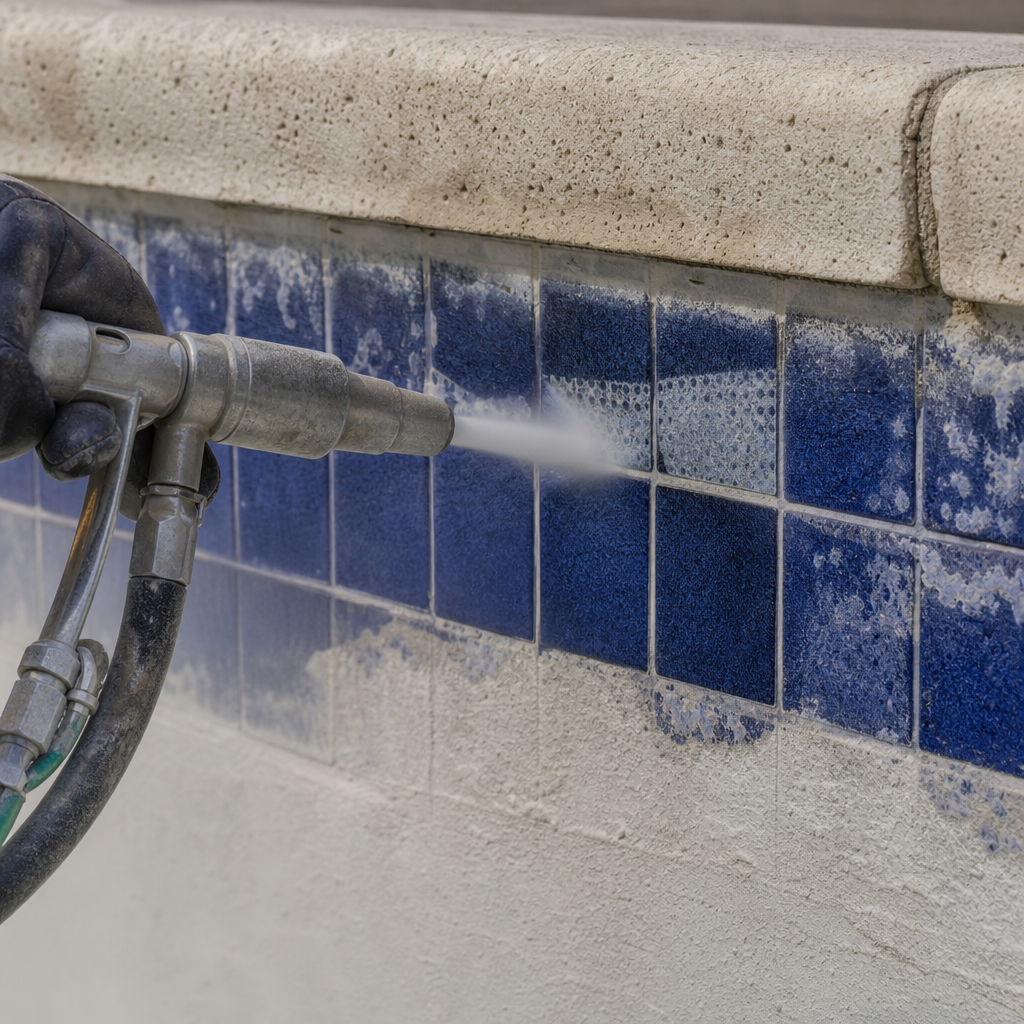
Calcium and scale removal strips the hard white mineral crust off your pool’s tile and plaster, the buildup that brushing and chemicals can’t touch. In Chandler it typically costs $200–$500, with heavy deposits bead-blasted and priced by the linear foot of tile. If there’s a chalky white band creeping up your waterline, this is the fix.
Why Chandler pools scale up
Chandler tap water is hard, high in dissolved calcium and other minerals. Every day in the desert sun, pool water evaporates and those minerals stay behind and concentrate. When calcium hardness climbs past what the water can hold, it precipitates out and cements onto the first surface it touches: the waterline tile and the plaster right at the water’s edge.
The result is calcium scale, a rock-hard deposit that looks like white or gray crust. There are two kinds:
- Calcium carbonate: the more common, softer white scale. It responds to acid treatment and comes off relatively easily.
- Calcium silicate: a harder, grayish-white scale that acid barely touches. This is the one that needs bead blasting.
Both are standard in the East Valley because our water and our heat all but guarantee them. It’s not a sign you did anything wrong; it’s just Chandler water doing what Chandler water does.
How it comes off
Bead blasting is the go-to for heavy or silicate scale on tile. Fine media fired at low, controlled pressure chips the calcium off without cracking the tile or blowing out the grout. It’s precise, it doesn’t leave the scratch marks that hand-sanding does, and it gets the tile back to its original color. Because it’s labor that scales with the tile band, heavy jobs are usually priced by the linear foot.
Acid treatment handles softer carbonate scale on plaster and lighter tile buildup. When the scale is widespread across the plaster, not just the tile line, the right move is often a full acid wash, which strips the calcium along with any staining and a thin layer of old plaster in one pass.
The method should fit the deposit, and photos usually show which one does. Sometimes it’s bead-blasting the tile only; sometimes it’s a full acid wash; often it’s both.
Tile line vs. whole-surface scaling
If the calcium is confined to the waterline tile band, that’s a pool tile cleaning job, restore the tile, leave the rest of the pool alone. If the scale has spread down onto the plaster across the pool, you’ve moved into acid-wash territory. The dividing line matters for both the method and the price, and it’s easy to see from a close-up photo of the waterline plus a wide shot.
Why this is worth doing
Beyond looks, unchecked calcium is a problem. It roughens the surface, which makes it easier for more scale and algae to grab hold. It clouds tile and can build up in the heater and plumbing. Left long enough, a solid calcium band becomes a genuine restoration job instead of a quick tile clean. Handling it while it’s a thin line is cheaper than waiting until it’s a half-inch crust.
This is especially true for the big pebble and quartz pools in Ocotillo and Fulton Ranch, where there’s a lot of high-end waterline tile to protect, and for the older plaster pools in Sun Lakes and central Chandler that have decades of buildup.
Keeping it from coming back fast
Nobody can change Chandler’s water, but you can slow the return. Keeping your calcium hardness balanced, running proper circulation, and wiping the waterline tile down periodically all stretch the time between cleanings. Most Valley pools still need the tile line addressed every few years. That’s just the cost of a pool in hard-water country.
Bead blasting vs. other removal methods
There’s more than one way to take calcium off tile, and the wrong method does damage. Hand-scraping and putty knives chip tile and gouge grout. Pumice stones work on plaster but scratch glass and ceramic tile and are brutally slow on a full pool. Acid dissolves soft carbonate but barely touches hard calcium silicate and, used carelessly at the tile line, can etch the tile face and eat grout. Bead blasting (fine media at low, controlled pressure) is the method that removes even hard silicate scale cleanly without cracking tile or blowing out grout, which is why it’s the professional standard for heavy waterline calcium. The deposit decides the method, and for the hard grayish scale that’s common on established East Valley pools, blasting is almost always the right answer.
Whole-pool calcium and the acid-wash option
When calcium has spread well beyond the tile, hazing the plaster across the floor and walls, spot-treating the tile isn’t enough. At that point a full acid wash is usually the efficient move: draining the pool and washing the entire surface strips the calcium along with any staining in one pass, and leaves you with uniformly fresh plaster rather than clean tile above a scaled floor. From photos, we can say whether you’re a tile-only job, a surface job, or somewhere in between, and price it honestly either way. This is common on older Sun Lakes and central Chandler pools where the scale has had decades to spread.
Get a calcium removal quote
Send a close-up of your waterline and a wide shot of the pool to learn whether it’s a tile clean, an acid wash, or bead blasting, with a flat price. Free quotes across Chandler and the southeast Valley.
Frequently Asked Questions
How much does calcium removal cost in Chandler?
Calcium and scale removal typically runs $200–$500. Heavy calcium that needs bead blasting is often priced by the linear foot of waterline tile. The amount and hardness of the scale drive the number, and photos are enough for a flat quote.
Why won't brushing remove the white crust?
Calcium scale is a hardened mineral deposit cemented onto the tile and plaster, essentially rock. Brushing and normal pool chemicals don't touch it. It has to be physically removed by bead blasting or dissolved with acid treatment.
What is bead blasting?
Bead blasting fires fine media (like glass beads) at low pressure to chip hardened calcium off the tile without cracking the tile or grout. It's the standard way to handle heavy waterline scale, and it's cleaner and more controlled than sanding.
Will the calcium come back?
It can, because Chandler's water is hard and evaporation concentrates minerals. Keeping calcium hardness balanced and the waterline wiped down slows it. Most Valley pools need the tile line addressed every few years.